 Fewer pieces, better chosen.
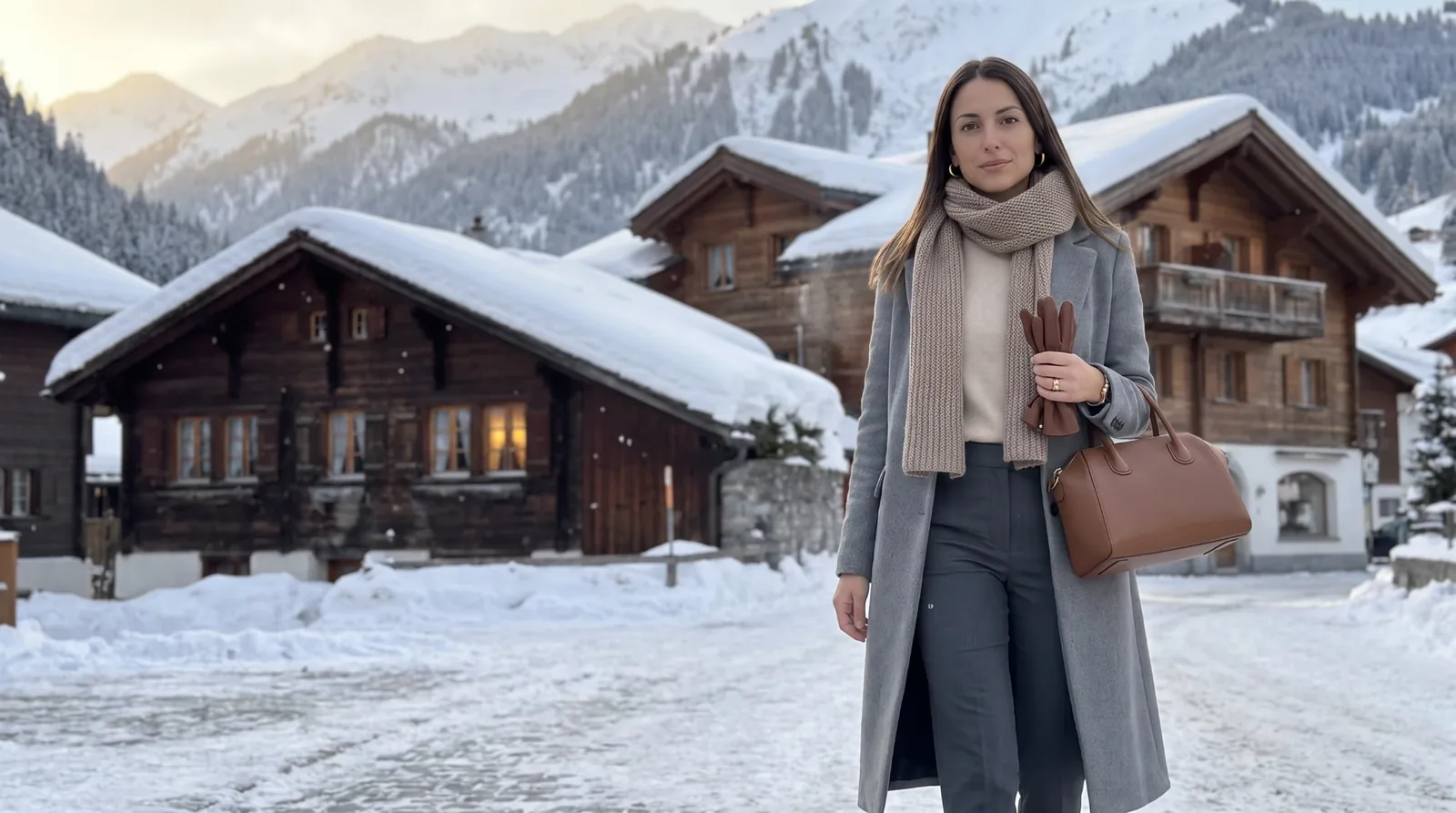
Quick answer, Madame: for Switzerland in winter, trade the technical pieces for tonal wool layers. Choose a structured wool coat, leather ankle boots with a grip sole, camel, grey and navy, a merino turtleneck, a leather tote or crossbody, and a beret or felt hat. Six swaps keep you warm and make you look like you belong in the village, not on the trail.
Picture it. Snow on the chalet roofs, a train gliding along a frozen lake, a long lunch in a warm, wood-panelled room. Switzerland in winter is a film set, and you deserve to look like you belong in it.
Now picture the photos. You are standing in front of the most beautiful view of your life, and you look like you are about to climb it. You were only going to lunch.
I see this mistake all the time, and I understand it completely. The shops that sell warm clothes for cold places are mostly outdoor shops, so “cold weather” quietly turns into “technical gear” before your suitcase is even open.
So let me be the friend with the good eye for a moment. This guide is about what to wear in Switzerland in winter when your days are made of towns, trains, cafés and hotel lobbies. If you will really be skiing or trekking, wear the technical gear. It was made for that. For everything else, six small swaps are all you need.
Each one comes with a before and after, so you can see the difference instead of just reading about it.
Prefer to watch first? Here is the quick version in about 40 seconds.
In this guide
- What alpine chic actually means
- The 6 swaps at a glance
- 1. Ski puffer to structured wool coat
- 2. Trail sneakers to leather ankle boots
- 3. Neon colorblock to tonal neutrals
- 4. Hiking backpack to leather tote or crossbody
- 5. Synthetic thermal to merino turtleneck
- 6. Ski beanie to wool beret
- The small things that finish the look
- What about après-ski outfits?
- A 12-piece winter capsule for Switzerland
- Frequently asked questions
What alpine chic actually means
Alpine chic is a way of dressing for a snowy mountain town that gets its warmth from natural fabrics and tailoring instead of technical gear. Think structured wool outerwear, leather boots, tonal neutral colors and a few polished accessories. It is the opposite of dressing for the slope when you are standing in the village.
Elegance has no label. It has attitude, curation and intention, and a snowy mountain town rewards all three.
It suits Switzerland especially well because of how a winter day unfolds there. You walk through freezing streets, then step into a heated train, a heated restaurant, a heated hotel lobby. The smartest outfit is the one you can open up without losing the look. A coat that looks lovely unbuttoned. A turtleneck that stands on its own the moment the coat comes off.
Swiss style is also generally understated, which is exactly why a neon ski suit in a village square stands out more than you would think. If quiet luxury is new to you, my guide to what Old Money style really is explains the thinking behind everything below.
The 6 swaps at a glance
Save this table for packing day. The detail and the pictures follow right after.
| Instead of (reads as gear) | Wear (reads as alpine chic) | Why it works |
|---|---|---|
| Technical ski puffer | Structured wool coat | Dense wool blocks wind, and the cut looks intentional |
| Chunky trail sneakers | Leather ankle boots with a grip sole | Handles cobblestones and snow without looking technical |
| Neon colorblock | Tonal camel, grey and navy | Neutrals look richer against snow |
| Technical hiking backpack | Structured leather tote or crossbody | Carries what you need in town, without the tourist signal |
| Visible synthetic thermal layer | Merino wool turtleneck | Warm, matte, and lovely enough to wear on its own |
| Technical ski beanie | Wool beret or structured felt hat | Same warmth, completely different look |
1. Swap the ski puffer for a structured wool coat
A technical ski puffer reads as gear, not style. Add leggings, trail shoes and a hydration pack and the message is complete: this woman is here for the mountain, not the town.
A structured wool coat gives you the same warmth with none of the trail-ready look. Choose a long, single-breasted cut in grey, camel or navy, lined, and just roomy enough to sit over a knit. Tightly woven wool stops wind far better than most people expect, and the length covers the thigh, which is where you feel the cold first when you are waiting on a platform.
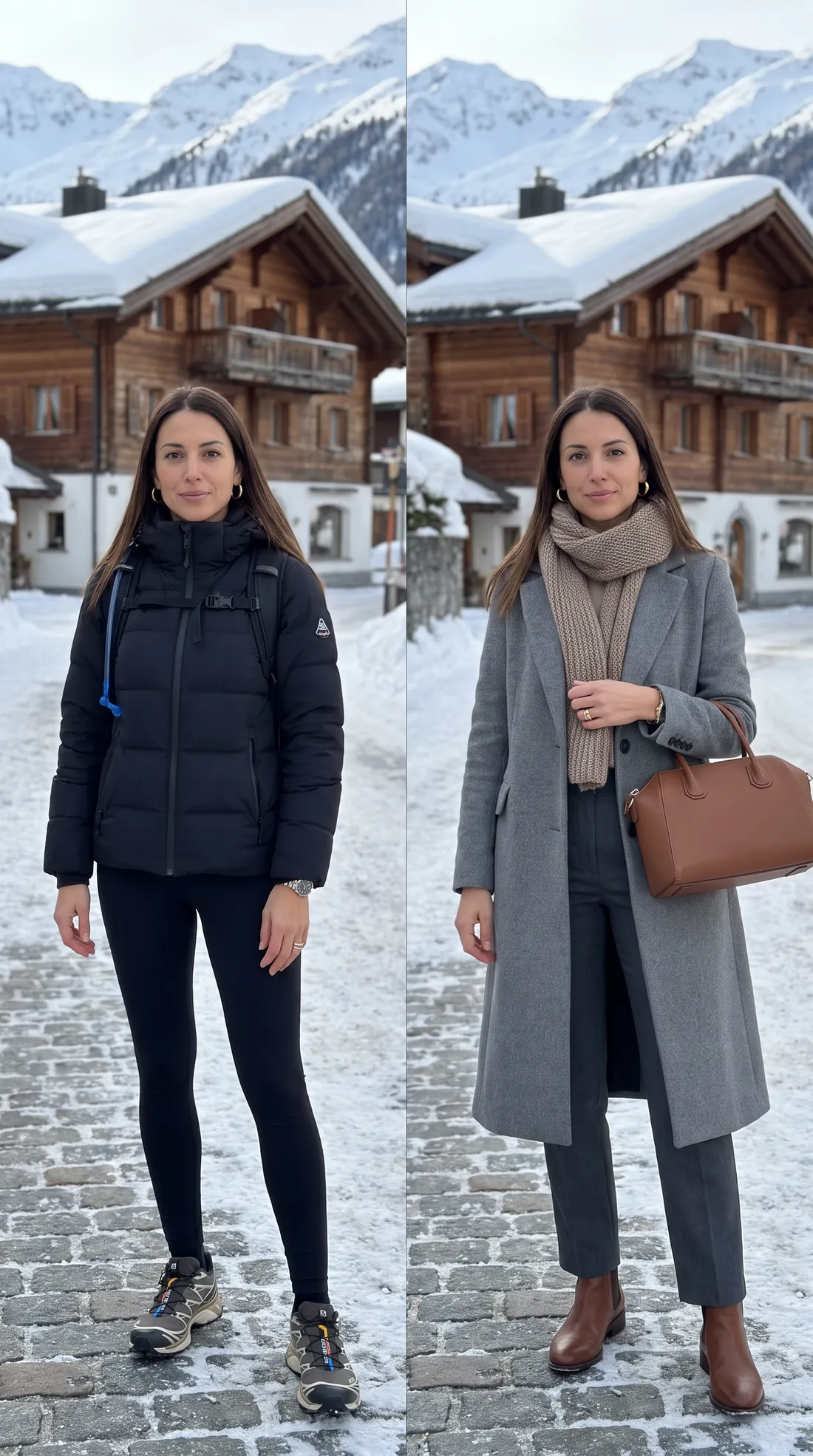
If I were you, this is where I would spend first. There is a quiet bonus too. A wool coat will serve you for many winters, in your own city, long after the trip. A puffer bought for one holiday usually ends up at the back of the closet. Buying less and choosing better is, for me, the whole point.
One honest caveat. On a very cold day at altitude, a coat alone will not be enough. Do not solve it with a bulkier coat. Add a fine merino layer and a scarf underneath, and you keep the silhouette. And if you truly cannot give up a puffer, pick a matte, longer one in a dark neutral with no visible logo. It reads far quieter than the black sport version.
2. Swap chunky trail sneakers for leather ankle boots with grip
Chunky hiking sneakers are the fastest giveaway. They are also the item most women regret, because mud and slush show on them in a way they never do on dark leather.
A leather ankle boot with a grip sole still handles cobblestones and snow, but it reads elegant instead of technical. Look at the sole before you look at the upper. You want a rubber sole with real tread, not a smooth fashion sole that turns a snowy street into a skating rink. A Chelsea boot or a lace-up ankle boot in black, brown or cognac will work with everything in your suitcase.
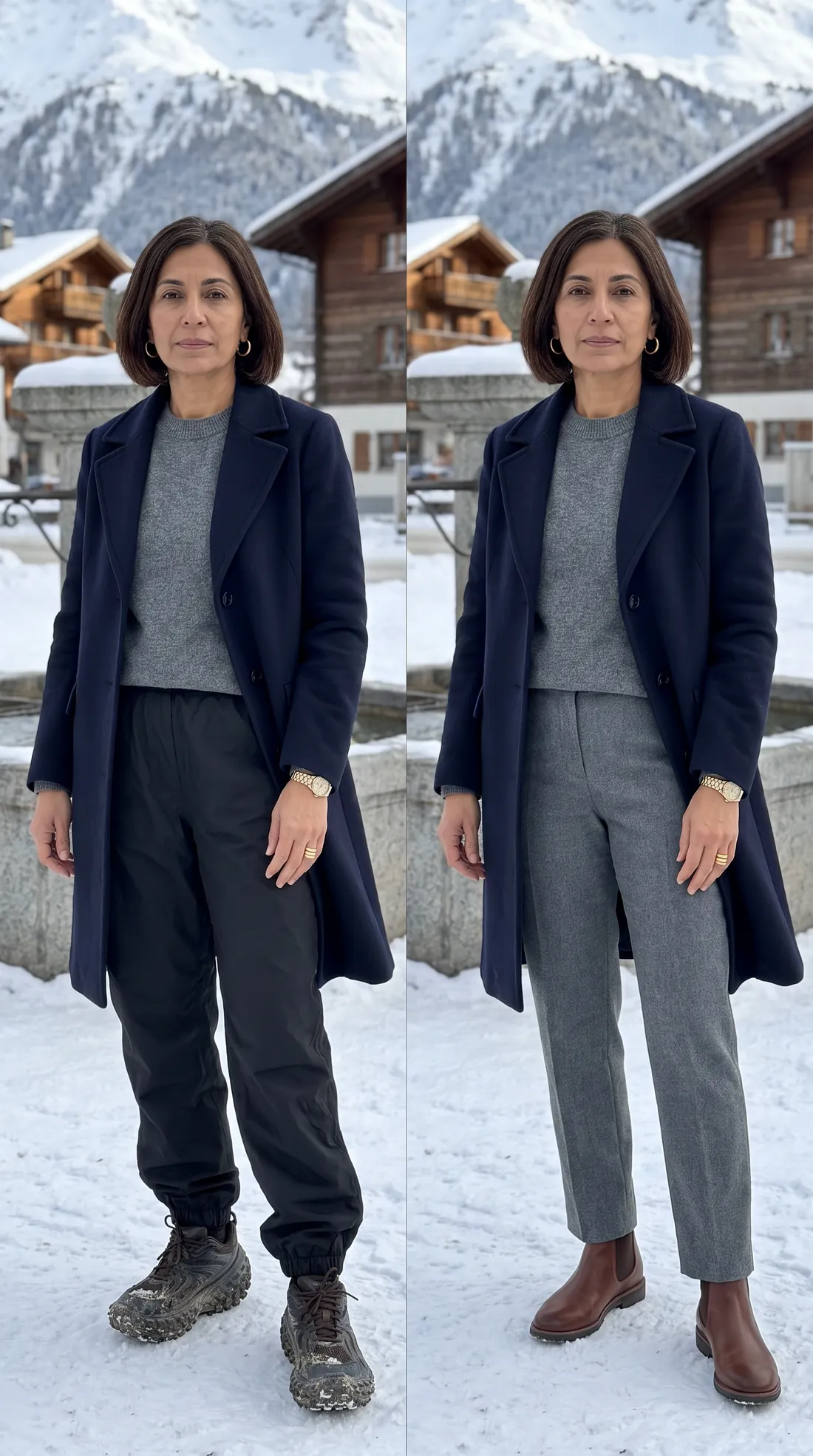
Pair them with straight-leg wool trousers that finish right at the ankle, and a thin sock that barely shows. That is the detail that changes everything. And do one small thing before you leave, which I will come back to below: waterproof the leather.
3. Swap neon colorblock for tonal neutrals
Bright athletic colorblock belongs on a ski slope, where being seen is a safety feature. In a village it simply shouts.
Tonal neutrals are what actually read as alpine chic: camel, grey and navy, worn in the same family from coat to trousers. Snow is a white backdrop, and neutrals look richer against it than they do almost anywhere else. If you want one deeper accent, forest green or burgundy sits beautifully with all three.
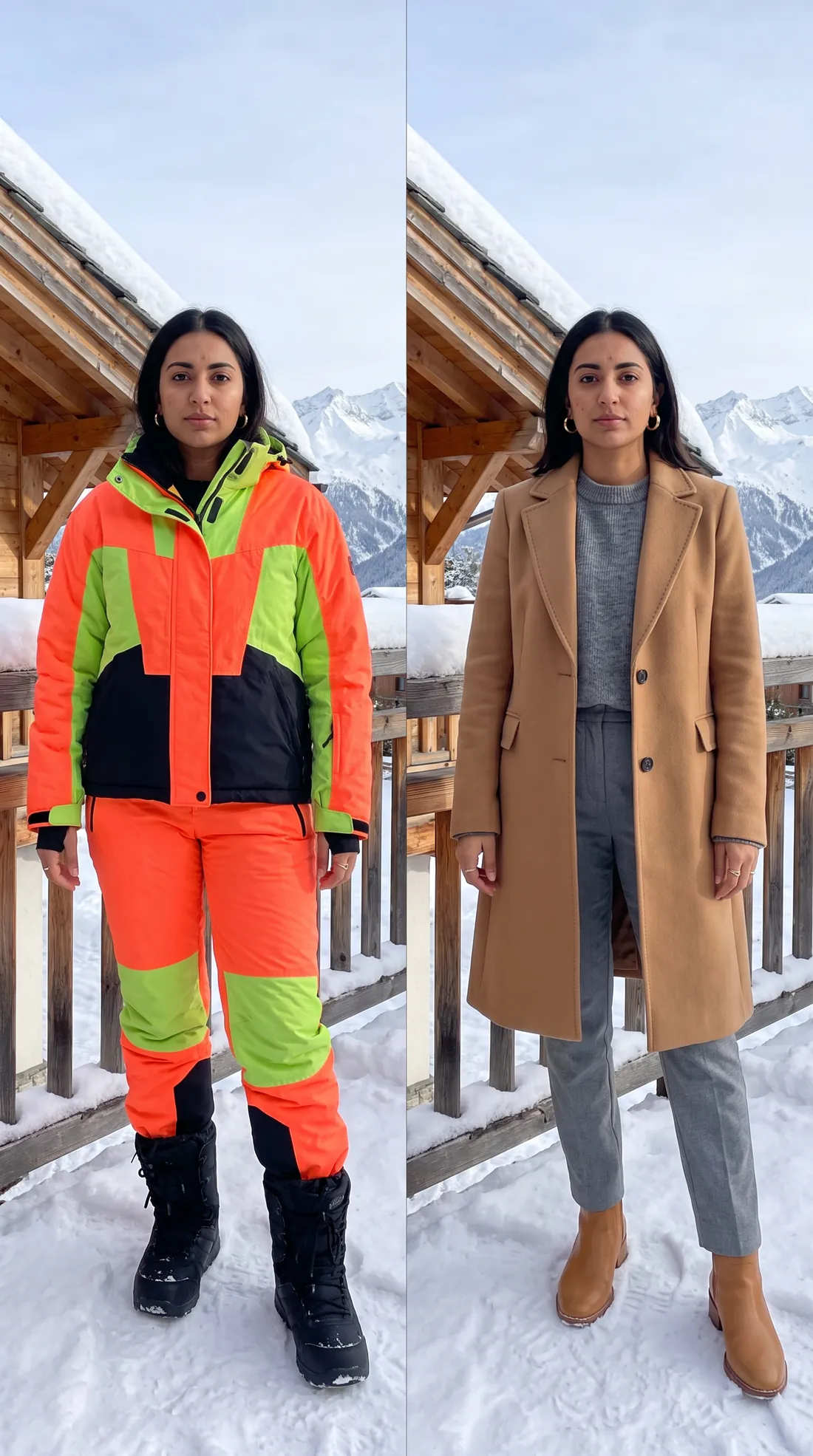
Here is the simple formula I love for travel capsules: coat in one neutral, knit in a second, trousers in a third, all within the same warm or cool undertone. Then you never have to think about it again, Madame. Everything goes with everything.
4. Swap the hiking backpack for a structured tote or crossbody
A technical hiking backpack instantly signals tourist. It also drags on the shoulders of your coat and flattens the line you worked so hard to build.
A structured leather tote or a crossbody carries just as much of what you actually need in town: phone, wallet, passport, gloves, a small bottle of water, your train tickets. Choose one with a zip or a firm closure, because snow and open bags do not get along. On cobblestones and station stairs the crossbody is the one that keeps your hands free for the railing.
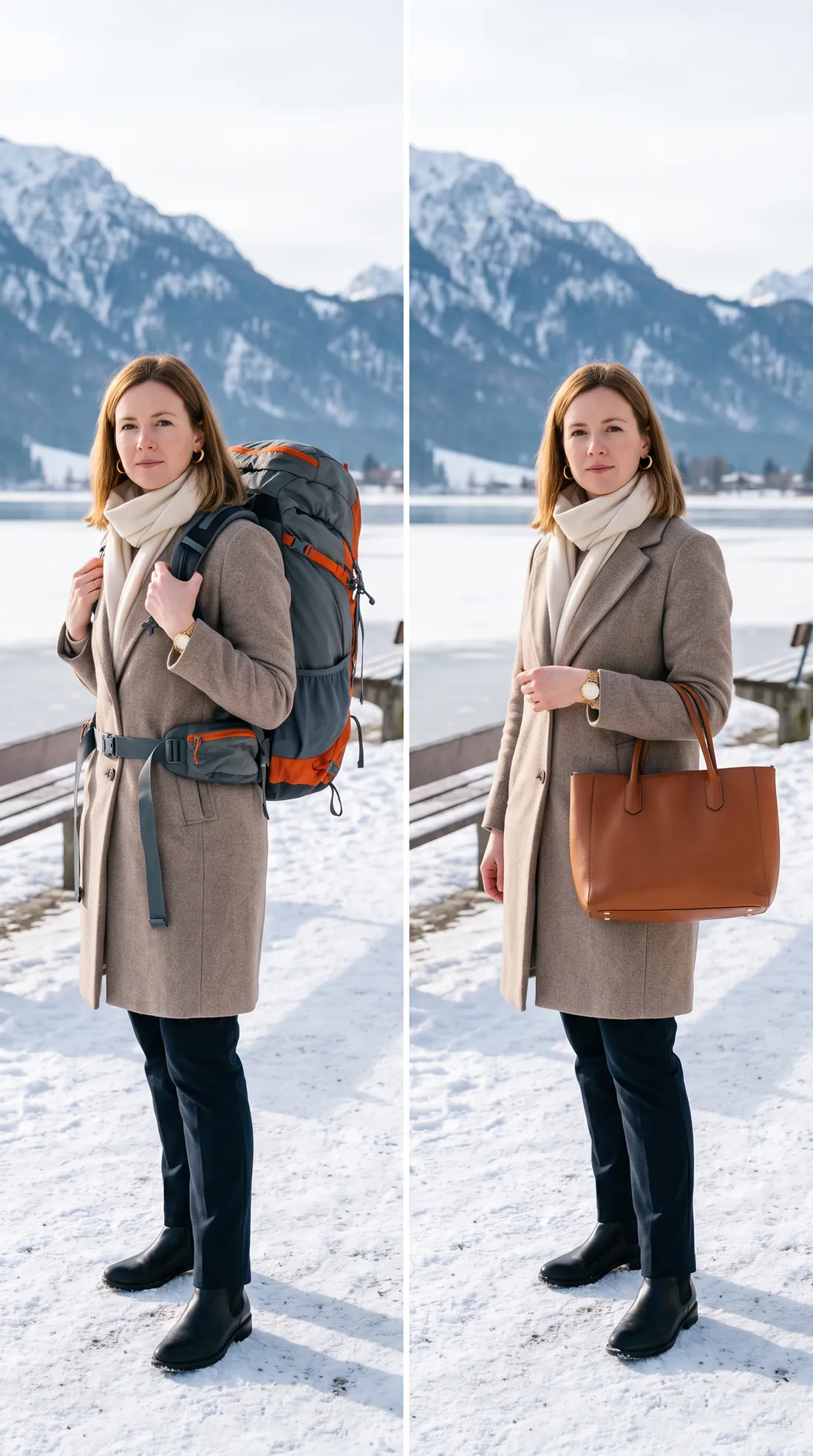
Keep the backpack for the one day you really hike. Leave it at the hotel for every other day.
5. Swap the synthetic thermal for a merino turtleneck
Moisture-wicking thermal fabric peeking out at the neckline is a dead giveaway. You can see the shine, the flat seam, the athletic cut. It looks like an under-layer because it is one.
A merino wool turtleneck keeps you just as warm and looks completely intentional. Wool fibers take up moisture vapor before they start to feel damp, which is why merino has such a loyal following for temperature regulation. A word of caution: many of the big percentages you see online come from wool industry research, so I would not get hung up on the numbers. What matters in real life is simple. It feels soft, it stays matte, and it does not smell after a long day of trains and lunches.
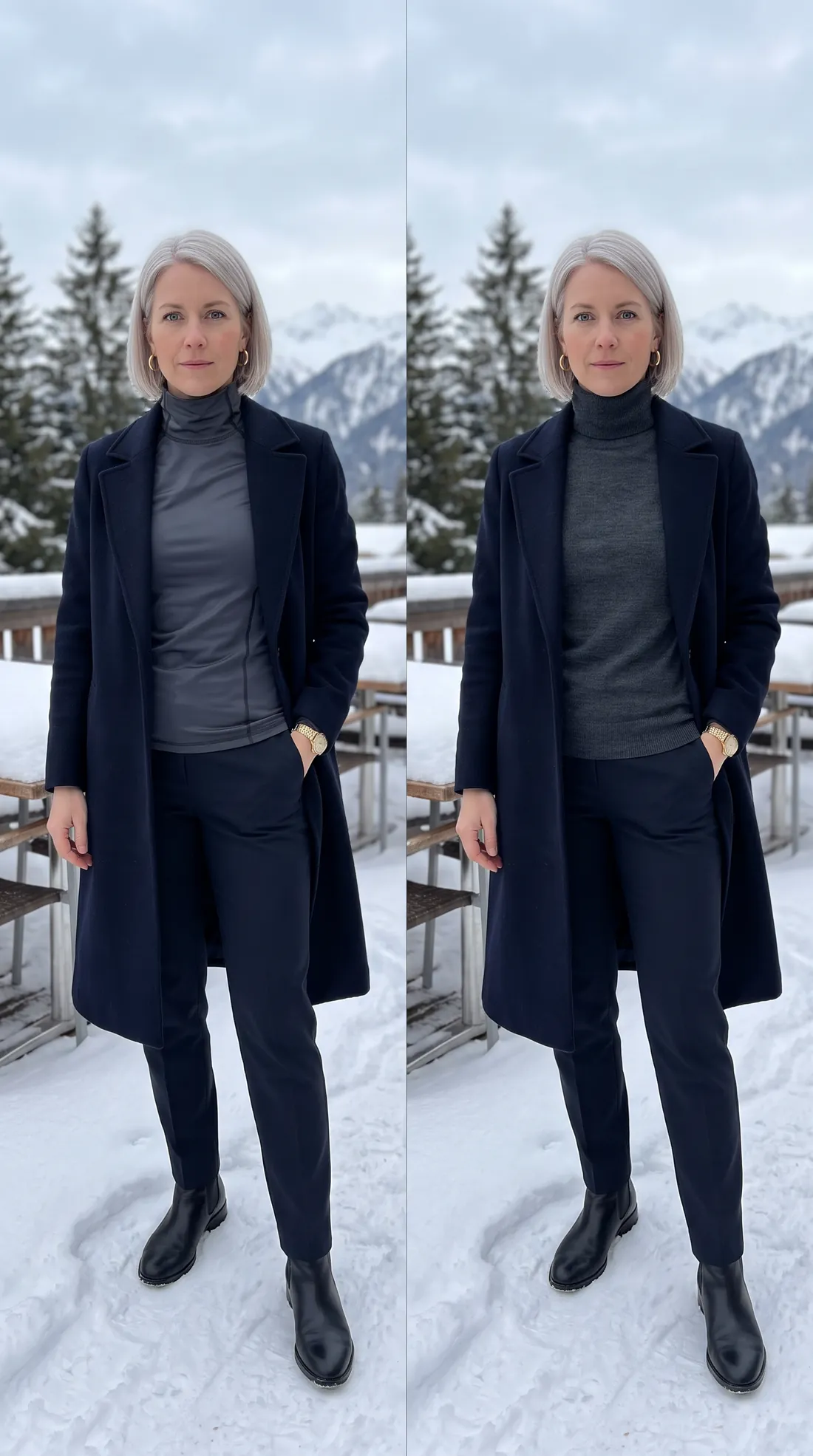
Choose a fine gauge in charcoal, cream or navy, in merino or a merino blend. It is the most useful layer in a Switzerland winter wardrobe, because it works under the coat outdoors and on its own the second you walk into a heated room. This is the kind of piece I would put straight into my own capsule.
6. Swap the ski beanie for a wool beret or felt hat
A technical ski beanie is built for the slope, not the village. The logo, the synthetic pompom and the sport sunglasses that usually come with it all say the same thing.
A wool beret or a structured felt hat gives you warmth with an entirely different look. Pair it with classic acetate sunglasses, in tortoiseshell or black, and the whole outfit moves from trail to town in one gesture.
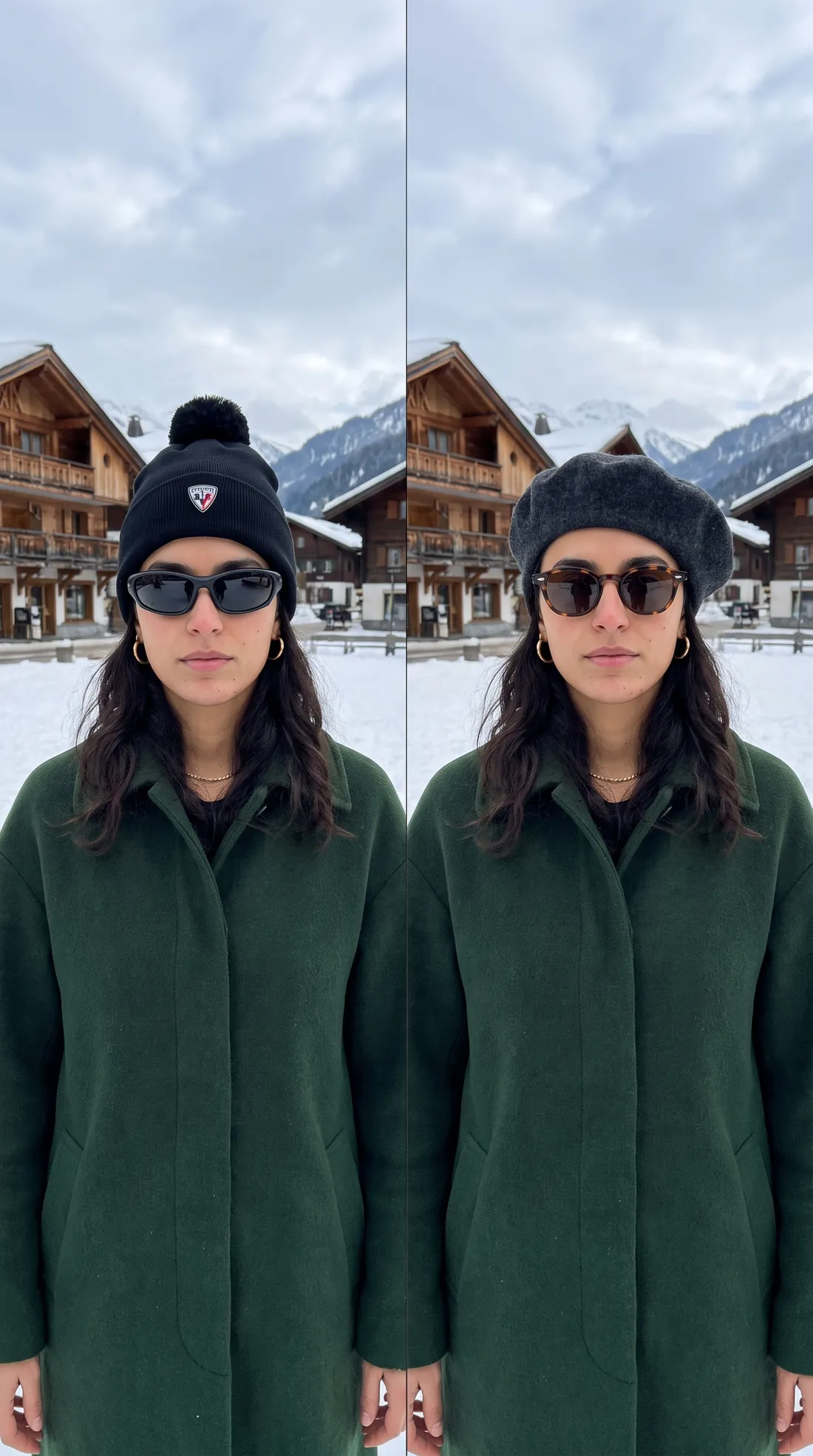
A beret keeps the top of your head warm but leaves your ears out. On the coldest days, choose a felt hat that sits lower, or tuck a thin knit headband underneath.
The small things that finish the look
Most women forget these. They are also what separates an outfit from a look.
Leather gloves with a soft lining
They keep your hands warm and still look polished when you are holding a coffee or a train ticket. Technical gloves with bulky cuffs bring the gear look straight back, so this is a place to spend a little more.
Sunglasses, even in winter
Snow reflects sunlight, and altitude adds to it. A WHO guide to the UV index notes that ultraviolet levels rise by roughly 10 to 12 percent for every 1,000 meters of altitude, and that fresh snow can reflect up to 80 percent of UV radiation (WHO, Global Solar UV Index guide, archived copy). In plain terms, the glare in the mountains can be stronger than on a summer beach. Pack them.
A waterproofing spray for leather or suede
Spray your boots a few days before you leave, not the night before, so it has time to dry and set. Slush and street salt will not leave marks the way they would on untreated leather.
What about après-ski outfits?
Après-ski is the social part of a ski day: the drink, the fire, the long afternoon after the slopes. If you will be skiing, you will want something lovely to change into, and this is where alpine chic is easiest to get right.
Skip the ski-wear and the retro color-blocked sets. Build the village version instead: a soft knit in cream or grey, wool trousers, leather boots and your coat over the top. A chunky après-ski sweater is the one place where texture is allowed to do the talking. Keep everything else quiet.
- Top: chunky knit or fine merino turtleneck
- Bottom: straight wool trousers in grey or navy
- Shoes: leather ankle boots with a grip sole
- Layer: the same structured wool coat you wore all day
- Finish: lined leather gloves and classic sunglasses
A 12-piece winter capsule for Switzerland
If you want the whole idea in one suitcase, Madame, this is where I would begin. Twelve pieces, all neutral, all able to combine with each other:
- One long structured wool coat (grey, camel or navy)
- One merino turtleneck in a light neutral
- One merino turtleneck in a dark neutral
- One chunky knit sweater in cream or grey
- Straight wool trousers in grey
- Straight wool trousers in navy
- One pair of leather ankle boots with a grip sole
- One structured leather tote or crossbody
- One wool or cashmere scarf
- One pair of lined leather gloves
- One wool beret or structured felt hat
- One pair of classic sunglasses
Twelve pieces give you far more outfits than the number suggests, because every one of them works with every other. This is the same logic I explain in my capsule wardrobe guide: fewer pieces, more combinations, fewer regrets in the suitcase. You do not need to have everything. You need to know what to choose.
It is also the thinking behind my Switzerland Travel Capsule. Every piece is planned for the Alps across all four seasons, with 12 to 16 pieces per season, 18 looks per season (72 looks in total), a packing checklist and a suitcase that stays within 10 kg. You arrive in the mountains already dressed like you belong there.
Going on to Italy after the Alps? The same approach works in warmer weather in these summer outfits for Italy.
Frequently asked questions
What should I wear in Switzerland in winter?
Wear layers in natural fabrics: a merino turtleneck, a knit, straight wool trousers, a long structured wool coat, leather ankle boots with a grip sole, a scarf and lined leather gloves. Stick to camel, grey and navy. Add sunglasses, because snow glare is strong.
What should I wear in Switzerland in December?
The same layers work. December brings cold streets, possible snow and warm, heated interiors, so choose a wool coat you can unbutton, a merino turtleneck that works alone, and boots with a grip sole. Check the forecast for your dates and altitude before you pack.
What do people in Switzerland wear?
Swiss style is generally understated and smart-casual: neutral colors, good fabrics and a clean fit. Locals tend to avoid loud logos away from the slopes, which is why tonal wool layers blend in far better than bright technical gear.
Is there a dress code in Switzerland for tourists?
There is no strict dress code for visitors. Neat, neutral and well-fitted clothes are welcome almost everywhere, from trains to restaurants. Keep ski clothing for the slopes, and cover shoulders and knees if you visit a church.
Do I need a ski jacket if I’m not skiing?
No. A structured wool coat over a merino layer is enough for towns, trains and restaurants on most winter days. If it is very cold at altitude, add another thin layer underneath rather than switching to a technical jacket.
Can I wear sneakers in Switzerland in winter?
On dry city days, clean minimal sneakers are fine. On snowy or slushy days, leather ankle boots with a rubber grip sole are the better choice, because they give traction, stay dry and look more polished than chunky trail sneakers.
What should I wear for après-ski?
Choose a soft knit or merino turtleneck, wool trousers and leather boots, with your wool coat on top. It keeps you warm after the slopes and looks right in a village restaurant, without the ski-wear look.
How cold is Switzerland in winter?
Valley towns such as Interlaken often hover around freezing during the day and fall below at night, and mountain resorts are colder. Check the forecast for your exact dates and altitude, and pack layers you can add or remove.
One last thing before you pack
Here is the test I would use at the mirror. Look at each item and ask whether it could be worn on a slope or a trail without anyone blinking. If the answer is yes, and you are not going to the slope or the trail, that is the piece to swap.
Everything else you already know how to do, Madame. Wool, leather, a few quiet colors. Elegance in the Alps is not about owning more. It is about knowing what to choose, and choosing six good things instead of twenty doubtful ones.
Send this to the friend who is planning a trip to the Alps and already has a hiking backpack in her cart. She will thank you at the first photo.
Updated October 2026. Weather and altitude vary widely across Switzerland, so check the forecast for your dates before packing.


Pingback: Christmas Markets In Europe: What To Wear, 6 Stunning Looks
Pingback: What To Wear In London When It Rains: 6 Best Swaps
Pingback: Switzerland Outfits For Fall: 6 Best Color Combos